Top Signs You Need Garage Door Service – Don’t Ignore These
The signs that matter most are rarely the ones homeowners call us about. A door that hesitates for two seconds before it moves isn’t “getting old.” It’s a torsion spring that has lost enough tension to put your opener motor under load it was never rated for, and in most cases that motor will fail before the spring finally gives out. We’re writing this piece in Upper West Side because the sound you’re hearing is usually a symptom of a mechanical condition that’s been degrading for weeks. If you’d rather have it looked at than guess, call (866) 937-7438.
Key Takeaways
- Noise, slowness and small gaps are symptoms, not the problem. Diagnose the mechanism underneath them.
- Cosmetic issues (faded panels, surface rust) and mechanical warnings (uneven cable tension, an asymmetric floor gap) are not the same tier of problem.
- A door that moves fine by hand but strains on the opener is a force-limit problem, not an opener problem.
- Upper-floor and rooftop installations in Manhattan buildings wear faster because of temperature differentials, so service intervals should be shorter.
- A door that reverses only in cold weather points to a logic board temperature issue, not a photo-eye.
Why Do Garage Door Problems Show Up Late?
Garage doors fail gradually, then announce it all at once. That’s the part that catches people. Every component in the system – springs, cables, rollers, hinges, the opener drivetrain – shares the lifting load. When one part drifts out of spec, the others quietly take up the slack. The door keeps opening. Nothing looks wrong. By the time you notice a symptom, the components doing the extra work are already near the end of their service life.
This is exactly why we treat warning signs as a diagnostic sequence instead of a checklist. The question isn’t “is my door noisy?” It’s “which component is making the others compensate?” Those are different questions, and they lead to very different repair bills. A homeowner who catches a worn roller early spends a fraction of what a homeowner spends after a cable snaps and the door drops off its track.
In Upper West Side, we also work inside a specific housing stock: pre-war buildings, conversions, townhouses and rooftop additions where the garage isn’t always at street level. That changes the wear math, and we’ll get to it further down.
Cosmetic Symptoms vs. Mechanical Warning Signs
Cosmetic issues can wait. Mechanical warning signs can’t – they signal imminent failure of a load-bearing component. Knowing which category you’re looking at is the single most useful thing a homeowner can learn, because it tells you whether you need a service call this week or next season.
Usually cosmetic (schedule it, don’t panic)
- Faded or chalky paint on steel panels
- Surface rust bloom along the bottom edge of a panel
- Cosmetic dents that don’t affect travel or sealing
- Peeling weatherstrip that still contacts the floor
These are appearance and long-term protection issues. On Clopay or Amarr steel doors, surface corrosion tends to start at the bottom panel where moisture sits. Cleaning and touching up stops it from spreading into the panel structure.
Mechanical (call it in)
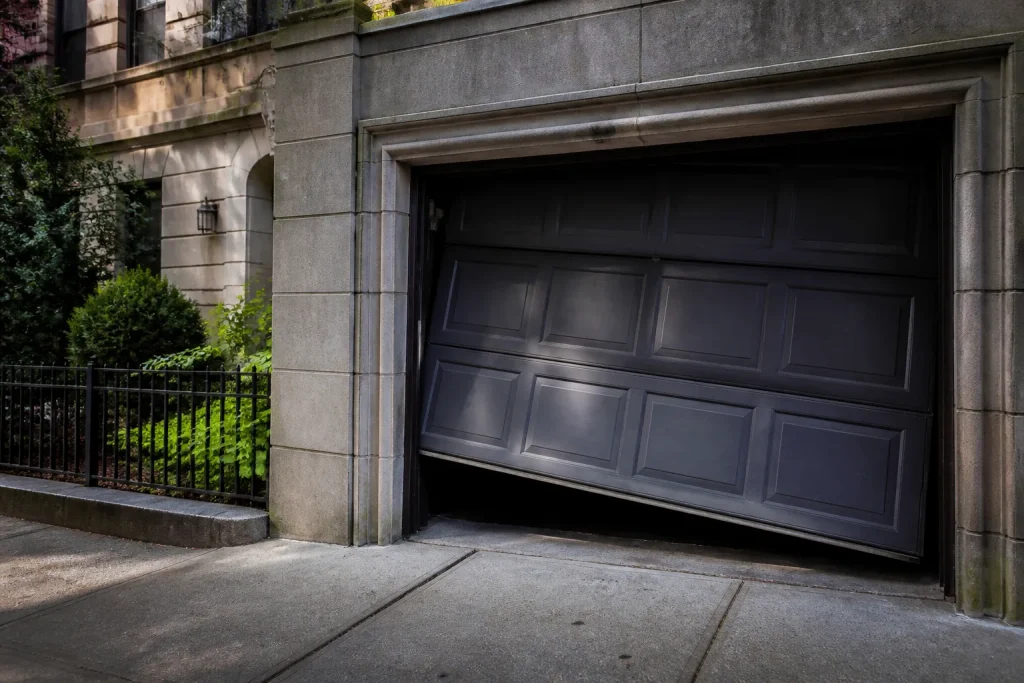
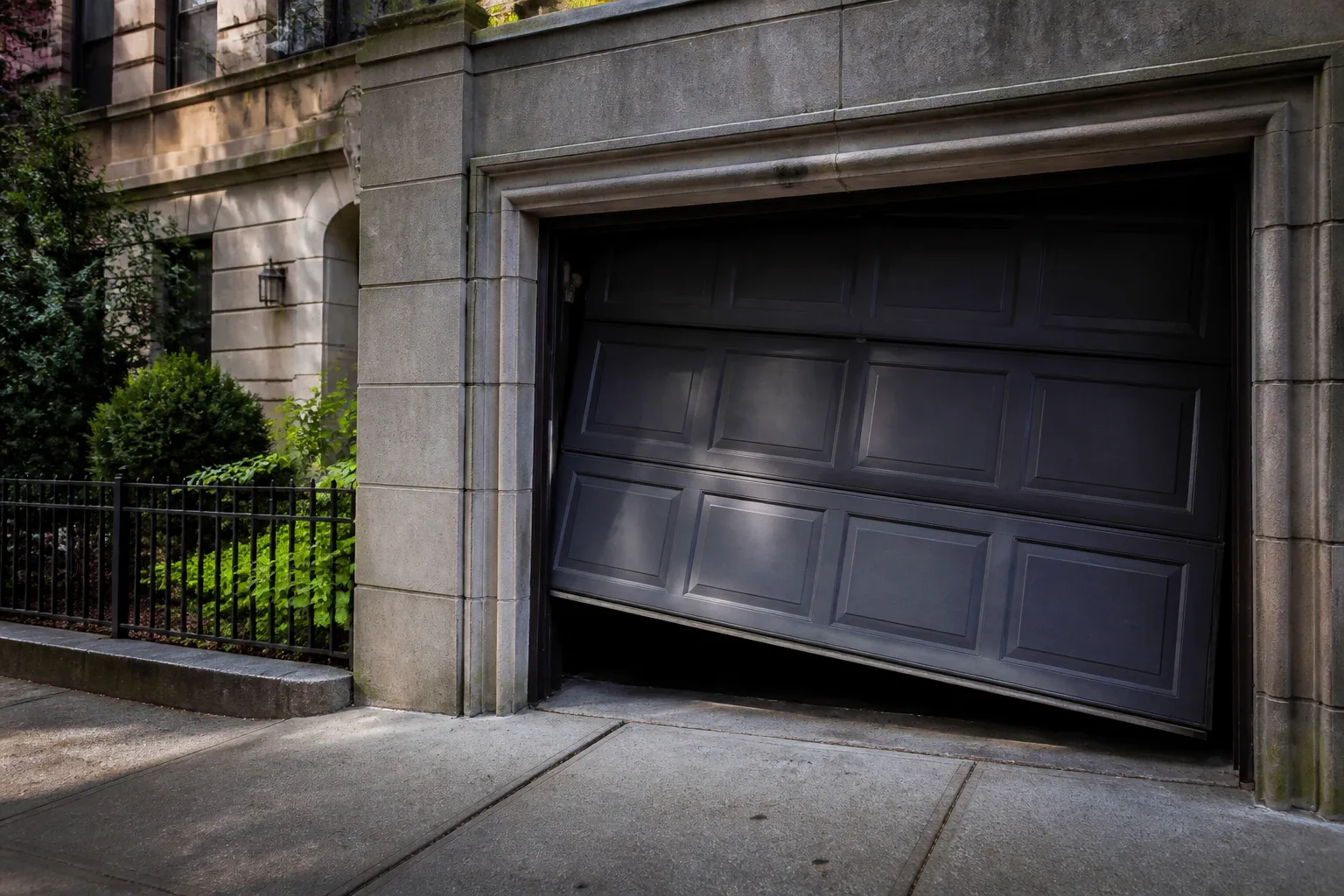
- An asymmetric gap at the floor seal – one corner touching, the other floating
- Cables that look slack on one side or have jumped their drum
- The door binding or racking as it travels up one side faster than the other
- Visible separation at the hinge plates, or a bent track section
- Any sign of a broken spring: the door won’t lift, or lifts a few inches and stops
An uneven floor gap matters more than it looks. It usually means the door is no longer level, which means the lift force is split unevenly across the two sides. That’s a cable and spring issue wearing into a track issue.
The Door That Works by Hand but Struggles on the Opener
This is the most misdiagnosed situation we see. When the door moves smoothly by hand but the opener labors, the problem is almost always the door’s balance – not the opener. The opener’s job is to nudge a balanced door. If the springs have lost tension, the opener is now doing work the springs should be doing, and every cycle wears the gear and motor harder.
Here’s what that means for the drivetrain. Chain and belt drives on LiftMaster and Chamberlain units are built to move a balanced load. Push one against a heavy, under-sprung door for long enough and the failure moves down the line: stripped nylon gears, a burned-out capacitor, a motor that trips on thermal overload. We’ve seen plenty of openers replaced when the real fix was a spring adjustment and a balance check.
That’s the difference between brand-specific diagnostics and guesswork. When we test a door, we disconnect the opener and check its balance in the halfway position first. If it doesn’t hold roughly where you leave it, the springs are the story – not the motor.
Safety note: torsion springs and the cables under tension are the most dangerous parts of the system, and a loaded spring can cause serious injury if it releases. We don’t recommend adjusting or replacing springs yourself. Let a trained technician handle anything under load; a garage door technician knows how to release that tension safely. If you need garage door opener repair, we’ll check the door’s balance before we recommend replacing any opener.
What the Sound Is Telling You
You don’t need to fix anything – just learn to describe the noise accurately. A technician who knows what you’re hearing before arriving can bring the right parts on the first visit. Here’s how to tell three common culprits apart.
Spring approaching coil bind or failure
A torsion spring near the end of its life has a tight, metallic creak or a sharp pop at consistent points in the travel. It sounds like metal under strain, because that’s what it is. If you hear a loud bang from the garage and the door won’t lift afterward, stop operating the opener: a spring has likely failed, and forcing it can drop the door.
Worn rollers
Worn rollers produce a rumbling, grinding or gravelly sound that tracks the whole length of the travel. Nylon rollers tend to flatten and develop a flat spot; steel rollers wear loose in the stem. The noise is continuous, not intermittent.
Dry hinges and hardware
A dry hinge gives a short, high squeak or chirp at the hinge joints, usually louder as the door rounds the curve into the horizontal track. It’s the least urgent of the three, but it’s a cheap fix that prevents metal-on-metal wear at the pivot points.
A dull rattle that appears only at the top of travel is often just loose hardware. A rhythmic thump is usually a roller or a drum. And a door that hesitates before moving, with no obvious noise, is often a spring that has lost tension. If you’re describing any of this from your garage in Upper West Side right now, we can help you sort it out.
Why Upper-Floor and Rooftop Garages Wear Faster
Upper-floor and rooftop garage installations are common in Manhattan buildings, and they change how fast a door wears. A rooftop garage is exposed to a much wider swing between daytime and overnight temperatures than a ground-level door tucked under a building. Metal expands in the heat of the day and contracts overnight, cycle after cycle, through every season.
What that does over time:
- Springs lose tension sooner. Torsion springs are rated in cycles, and thermal movement adds stress beyond normal use. A rooftop spring reaches the end of its life earlier than an identical spring on a sheltered door.
- Seals and weatherstrip age faster. Repeated expansion and contraction makes rubber and vinyl weatherstrip crack and lose contact with the floor.
- Cables stretch and slip. Temperature cycling on an exposed steel cable shows up as slightly uneven tension on one side.
- Openers work harder in the cold. A motor rated for a sheltered installation runs closer to its limits when the door drags against stiff seals and cold grease.
The practical result: a rooftop or upper-floor door in Upper West Side should get a balance and hardware check more often than a sheltered ground-level door. Shortening the service interval is cheaper than an emergency call in a cold snap.
The Sign Almost Nobody Mentions: Reversing That Only Happens in Cold Weather
A door that reverses on closing is usually a misaligned photo-eye. When it reverses only when it’s cold, it usually isn’t. The more likely cause is a logic board that has become temperature-sensitive – the board’s behavior drifts at low temperatures, and the door reopens as if it detected an obstruction that isn’t there.
That distinction matters because the two problems have completely different fixes. You can realign a photo-eye yourself in a few minutes and it costs nothing. A temperature-sensitive logic board on a Craftsman or Genie unit needs proper diagnosis, and sometimes replacement. Replacing the wrong part first wastes time and money.
A quick way to tell them apart
- Check the photo-eye first. Look for a blocked lens, a loose bracket or a misaligned path between the two sensors, and confirm the indicator light on the sending unit responds. If the reversal happens in mild weather too, this is your answer.
- If the door only reverses in the cold, keep a note of the outdoor temperature and how often it happens. That pattern is the diagnostic clue a technician needs.
- Don’t keep cycling the door to “test” it. Repeated failed closes stress the opener and the door’s hardware.
Brand knowledge is what lets us get this right on the first visit. We work with LiftMaster, Chamberlain, Genie, Craftsman and Raynor openers regularly, and we know how each brand’s control logic behaves when it starts to fail. Brand-specific diagnostics, not guesswork.
When to Call a Pro
Some problems you can fix yourself: wiping down a track, tightening a loose bracket, replacing weatherstrip or clearing a photo-eye. Others need a trained technician from the start. Call us if any of these match what you’re seeing:
- The door won’t open or close at all, or it reverses on its own
- You hear a loud bang and the door won’t lift – a spring has probably failed
- One side of the door lifts faster than the other, or the door binds partway
- A cable is slack, frayed or off its drum
- The door is noticeably harder to move than it used to be
- The door is off its track or has dropped on one side
When the door won’t close late at night, or won’t open first thing before work, we treat it as an emergency call, not an upsell. We’re a single-trade company – 100% of our expertise is in garage doors, not plumbing, HVAC or general contracting – so the call covers it: repair, install, opener, emergency. Our technicians have up to 12 years of experience. Any price is quoted and agreed with you before work starts, so there are no surprises on the invoice.
If the door is genuinely beyond repair, or you’re planning a replacement while the tracks are already being worked on, we handle garage door installation for nearly every residential configuration, including Wayne Dalton and Raynor systems. We’re here to help with garage door repair too, whatever the brand already in your garage.
The Bottom Line
Most garage door failures don’t arrive without warning – they leave a trail of small symptoms for weeks beforehand. The key is reading those symptoms as a diagnostic sequence, not a checklist. Cosmetic issues can wait. Mechanical warnings can’t. A door that strains on the opener points to a balance and spring problem, not a failing motor. Keep a note of what your door sounds like and when it acts up, so a technician can diagnose it correctly on the first visit.
If you’re in Upper West Side and need help, Garage Door Repair Upper West Side offers free estimates – call (866) 937-7438. Our technicians will check the mechanism, not just the symptom, and tell you plainly what needs fixing now and what doesn’t.
Frequently Asked Questions
A door that hesitates before it moves, or one that moves fine by hand but struggles when the opener drives it. Both usually point to a spring that has lost tension rather than a worn opener. Call (866) 937-7438 for an exact quote – estimates are free.
Usually not. A photo-eye misalignment causes the door to reverse in any weather. If it only happens when it’s cold, the more likely cause is a temperature-sensitive logic board. Have it diagnosed properly rather than replacing the sensors first.
No – torsion springs and cables are under heavy load and can cause serious injury if they release. This is one job better left to a trained technician. Call (866) 937-7438 for an exact quote – estimates are free.
More often than a sheltered ground-level door. Wide temperature swings on exposed doors speed up spring wear, seal aging and cable stretch, so the service interval should be shorter. Call (866) 937-7438 for an exact quote – estimates are free.
Yes. We work on LiftMaster, Chamberlain, Genie, Clopay, Amarr, Wayne Dalton, Craftsman and Raynor equipment, and we start by diagnosing what’s already installed. Call (866) 937-7438 for an exact quote – estimates are free.
Written by the team at Garage Door Repair Upper West Side.
Need Garage Door Help?
Call Garage Door Repair Upper West Side - the local pro we connect you with is licensed and insured, here with fast after-hours help in Upper West Side.
(866) 937-7438