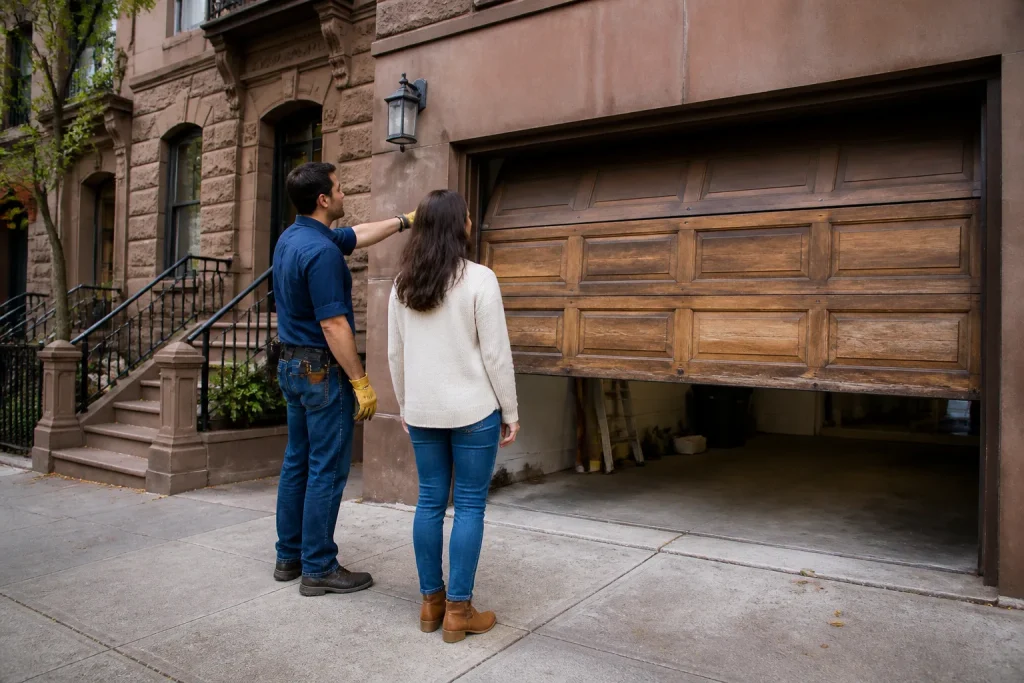
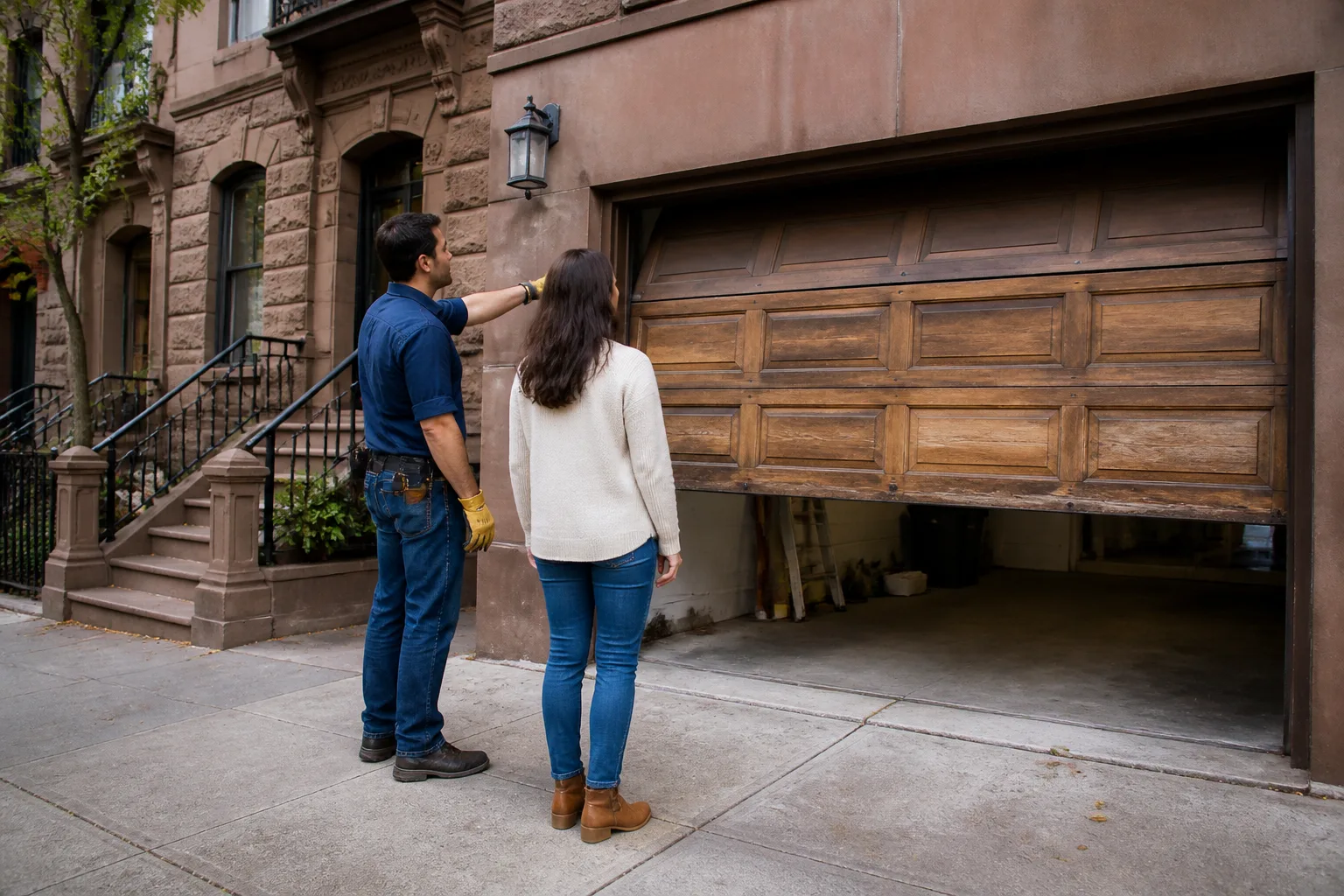
Garage Door Repair: Repair or Replace? How Upper West Side Homeowners Decide
Most Upper West Side homeowners assume the decision hinges on how old the door is. It doesn’t. The right call depends on which component failed, how much life the rest of the system has left, and what two years of sequential repairs will actually cost you. In a Manhattan co-op or condo, there’s another layer: replacement means board approval, a licensed contractor, and sometimes a structural assessment. That paperwork can push an owner toward a hasty repair to avoid the hassle, and that hasty repair is often the expensive one. If you’d rather hand the diagnosis to someone who works on doors all day, call (866) 937-7438.
Key Takeaways
- Springs and cables are consumables. Replacing them repeatedly is normal and usually smart.
- A cracked torsion bar, a damaged drum shaft, or a warped track changes the math entirely.
- The “50% rule” applies to the opener-and-hardware system, not the door panel alone. Most estimates confuse the two.
- Age matters less than how many components are failing at once.
- In pre-war garage bays, custom door lead times and co-op rules can justify a phased plan.
Why the Age of the Door Is the Wrong Number to Start With
A fifteen-year-old door can be a keeper. A ten-year-old door can be a money pit. The difference is which parts are wearing out, not the birthday on the panel.
Every garage door system is really two families of parts. The first family is consumable hardware: torsion springs, extension springs, cables, rollers, hinges, and bearings. These are designed to wear and be replaced. A spring that snaps after years of cycling is doing exactly what springs do. Replacing it is routine, not a sign the whole door is finished.
The second family is structural: the torsion bar, the drums and drum shafts, the vertical and horizontal tracks, the bottom brackets, and the panel faces themselves. When one of these fails, the picture changes. A cracked torsion bar or a bent track isn’t a wear item you swap and forget. It’s a sign the system is out of alignment under load, and patching around it tends to invite the next failure.
So the first question on any Upper West Side job isn’t “how old is the door?” It’s “what failed, and is it in the consumable family or the structural family?” That single distinction answers most of the repair-or-replace question before any price gets quoted.
The Component-Failure Hierarchy: What Repairs Well and What Doesn’t
We sort every failure into tiers, because the repair logic is different for each one. Here’s how it breaks down in plain terms.
- Tier one, replace freely: springs, cables, rollers, hinges, and bearings. These are meant to be serviced. A door with healthy structure and a broken spring is a repair, full stop.
- Tier two, replace with attention: the opener and its drive components. Openers (we work on LiftMaster, Chamberlain, Craftsman, and Genie systems regularly) have their own service life, separate from the door. A tired opener on a sound door is a straightforward replacement.
- Tier three, replace with caution: drums, drum shafts, and torsion bars. Damage here usually means the system has been stressed in a way that makes future failures more likely.
- Tier four, weigh replacement: warped or bent tracks, cracked bottom brackets, and damaged or rotted panels. When tier-four problems stack up alongside tier-one wear, the repair bill climbs toward the cost of a new system.
The hierarchy matters because it stops you from spending money on the wrong tier. Replacing a spring on a sound door is money well spent. Replacing a spring on a door with a warped track and a failing opener is money you may never see again. That’s the situation where a repair just delays the bigger bill.
How the 50% Rule Actually Works (And Where Most Estimates Get It Wrong)
The 50% rule is a simple idea: if a repair costs more than half of what replacement would run, replacement usually wins. The trouble is what you’re supposed to measure that 50% against, and most estimates Upper West Side owners receive compare the wrong things.
The rule applies to the opener-and-hardware system, not the door panel cost alone. Here’s why that matters. A door panel is one line item. The system that actually does the work includes the opener, the springs, the cables, the rollers, the tracks, and the mounting hardware. Comparing a repair quote to just the panel price makes repair look cheap when it isn’t. Comparing it to the full system cost gives you the honest ratio.
A correct comparison looks like this:
- Get the repair estimate, itemized by component.
- Get a replacement estimate for the equivalent system, itemized the same way.
- Divide the repair by the replacement. If it’s under half, repair usually makes sense.
- Weigh in the age of the components that aren’t failing yet. A repair on a system with several healthy years left is a better deal than the same repair on a system that’s already tired.
We’ve seen estimates that quietly leave the opener out of the replacement figure to make repair look like the obvious choice. Ask for the full system price before you compare. The written estimate should give you both numbers side by side.
Upper West Side Building Constraints That Change the Math
Replacing a garage door in Manhattan isn’t the same job it is in the suburbs, and that’s the piece most repair-or-replace articles skip. In a co-op or condo, three building-specific factors can push you toward repair, or toward a phased plan.
Custom-width doors and lead times. Pre-war garage bays on the Upper West Side often don’t match modern standard door widths. A custom or made-to-measure door can mean a longer order-and-install timeline than an off-the-shelf panel. If your door is structurally compromised and the replacement is weeks out, a temporary repair keeps the garage secure in the meantime.
Permits for structural work. If the repair or replacement touches the structural header above the opening, you may need a permit from the city’s Department of Buildings. Header modifications are a different scope of work than a straight hardware swap, and they add time and cost. Ask your building department what your specific bay requires before you sign anything.
Board and aesthetic rules. Many buildings restrict panel style, color, and material for anything visible from the street or courtyard. If the board won’t approve the panel you can afford, repair becomes the practical route. Get the board’s sign-off on a style before you order a door, not after.
These constraints don’t make replacement wrong. They make timing matter. Sometimes the smartest path is to repair now, confirm the lead time and the board’s approval, and replace on a schedule that doesn’t leave you exposed.
Repair, Replace, or Phase It? Reading the Whole System
Here’s the judgment call we make on every visit, and it comes down to one question: are multiple components failing at once? Age matters less than the count of failures.
A fifteen-year-old door with one spring failure is a repair. Replace the spring, check the cables and rollers, and move on. That door may have years left in it.
A ten-year-old door with a second cable failure, visible roller wear, and an opener that’s straining to lift is a different story. Three components going at once is a pattern, not a coincidence. Each repair is a separate bill, and over two years those bills add up toward a replacement you were going to need anyway. The door’s ten years don’t tell you as much as the fact that three parts have failed within a short window.
There’s a third path that gets overlooked: phased replacement. When the door is structurally sound but the opener is on its way out, replacing the opener now and planning a door replacement within twelve months can be the right sequence. It spreads the cost and keeps you operating while you sort out lead times and board approval.
Whatever path makes sense, ask your specialist to document the condition of the components you’re keeping. What’s the wear on the rollers? How do the tracks look? Is the opener lifting smoothly or working harder than it should? Those notes give the next visit a baseline and support the future decision with facts instead of guesswork.
When to Call a Pro
Some of this you can assess by eye: warped tracks, a door that hangs crooked, an opener that groans. But the two most dangerous components on the system, the torsion springs and the cables, are under enormous tension. They’re the parts that cause the worst injuries when a DIY attempt goes wrong. Spring failure is a safety issue, and we treat it that way.
We work on the brand already in your garage, whether it’s a LiftMaster, Chamberlain, Clopay, Amarr, or Raynor system, so we diagnose and source correctly the first time instead of guessing. If you want a second opinion on repair versus replace, or you’re facing a failure right now, garage door repair is the place to start. When the door won’t open, our garage door opener repair team handles the drive side, and if the system is truly finished, garage door installation covers the replacement end to end. Everything is quoted and agreed before any work starts, so the written estimate is the price.
Related services in Upper West Side: if you’re still weighing the whole picture, our Garage Door Repair Upper West Side page walks through what a diagnosis covers.
The Bottom Line
Repair or replace comes down to which component failed and how many others are close behind. Consumables like springs and cables are worth replacing repeatedly. Structural damage to the torsion bar, drums, or tracks changes the call. Apply the 50% rule to the opener-and-hardware system, not the panel alone, and weigh in the Upper West Side realities of custom lead times, permits for header work, and co-op approval. A fifteen-year-old door with one spring failure is usually a repair. A ten-year-old door with cascading failures usually isn’t. Our technicians have up to 12 years of experience, and we’ve worked on every failure mode this trade throws at a door. If you’re in Upper West Side and need help, Garage Door Repair Upper West Side offers free estimates. Call (866) 937-7438 and we’ll tell you straight which call makes sense for your door.
Frequently Asked Questions
Repair if the failure is limited to consumables like springs, cables, or rollers and the structure is sound. Replace if the repair cost exceeds half the replacement cost of the opener-and-hardware system, or if multiple components are failing at once. Call (866) 937-7438 for a free estimate and a straight answer.
The whole opener-and-hardware system, not the door panel alone. Comparing a repair quote to just the panel price makes repair look cheaper than it is. Ask for both the repair and replacement estimates itemized by component before you compare. Call (866) 937-7438 for an exact quote.
Often yes, if only one component has failed and the structure is healthy. Age alone isn’t the deciding factor. A sound door with a broken spring is a routine repair. Call (866) 937-7438 to have the whole system checked.
Repairs are often handled quickly, and emergency service is available when a door is stuck open, stuck closed, or unsafe. Replacement is a measured, ordered, and scheduled job, so it takes longer. Either way, the price is quoted and agreed before any work starts. Call (866) 937-7438 to get it booked.
Written by the team at Garage Door Repair Upper West Side.
Need Garage Door Help?
Call Garage Door Repair Upper West Side - the local pro we connect you with is licensed and insured, here with fast after-hours help in Upper West Side.
(866) 937-7438